
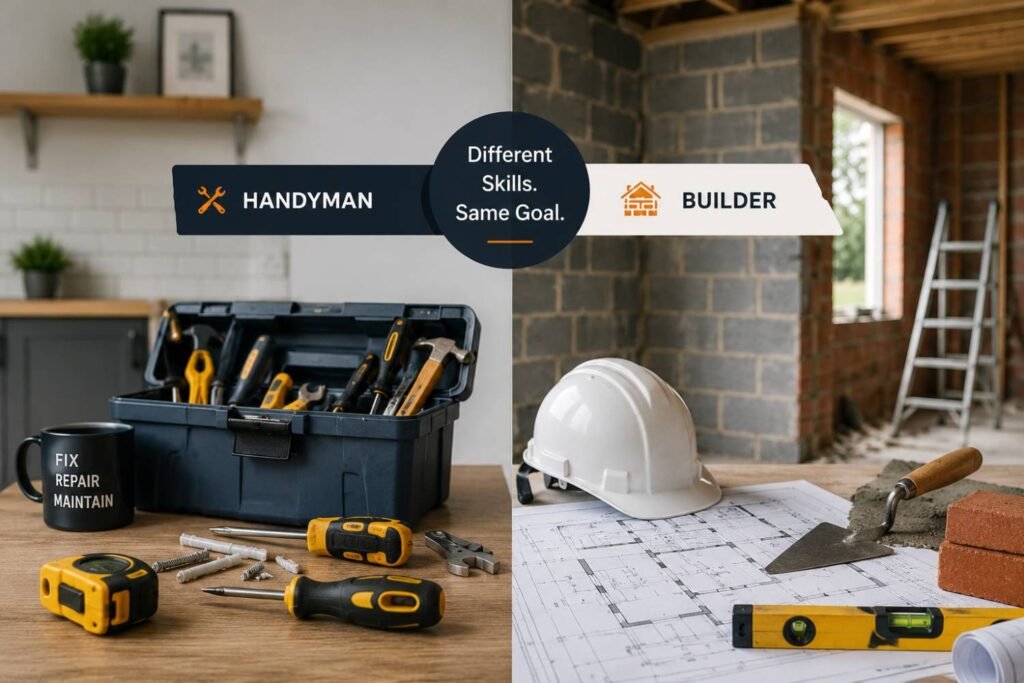
When planning repair, renovation, or maintenance work for your property, understanding the difference between a handyman and a builder can save you time, money, and stress. Although both professionals play essential roles in home improvement, their skills, qualifications, and the types of jobs they handle are not the same. At Fix in London, we help customers choose the right expert for their project by clearly explaining what each professional does.
1. Scope of Work
Handyman
A handyman specializes in small to medium-sized tasks. These include minor repairs, maintenance, and everyday improvement jobs such as fixing doors, painting, assembling furniture, repairing leaks, installing shelves, or simple electrical and plumbing work.
Handymen are ideal for quick, efficient solutions that don’t require structural changes or major construction.
Builder
Builders handle large-scale construction and renovation projects. Their work involves structural alterations, extensions, roofing, groundwork, bricklaying, and full home refurbishments. Builders often work with architects, engineers, and planning authorities because their tasks require detailed planning and regulatory approval.
2. Qualifications and Regulations
Handyman
Handymen in the UK generally do not require formal qualifications, although many have extensive experience or training in multiple trades. They can legally perform minor electrical or plumbing tasks, but anything involving certification—like major rewiring or gas work—must be completed by a licensed professional.
Read more: How to Choose Between a Handyman and a Specialist Contractor
Builder
Builders often hold trade qualifications such as NVQs, CSCS cards, or industry-specific training. Their projects typically require adherence to building regulations, planning permissions, and strict safety standards. For structural work, hiring a qualified builder is essential.

3. Cost Differences
Handyman
Handymen offer cost-effective solutions for smaller jobs. They usually charge hourly or per task, making them ideal when you need several small jobs done in one visit. This helps homeowners avoid the higher costs associated with hiring a specialist builder for simple fixes.
Read more: 7 Signs It’s Time to Call a Professional Handyman (Not DIY It)
Builder
Builders generally work on larger, long-term projects and charge higher rates. Costs may include planning, materials, labour teams, and project management. If a job involves demolition, structural changes, or major refurbishment, a builder is the right choice—despite the higher overall cost.
4. Project Size and Timeframe
Handyman
A handyman is perfect for tasks that can be completed within a few hours or days. They are flexible, quick to schedule, and ideal for homeowners who need fast, practical help with home maintenance.
Builder
Builders handle multi-week or multi-month projects that require coordinated teams, planning, and phased execution. These are long-term commitments and typically take more time due to inspections, regulations, and construction stages.
Local Availability Across London
Fix in London proudly serves homeowners across multiple London neighbourhoods. Whether you need a small repair or a planned improvement, our experts are ready to help. We also provide services for Handyman in Stoke Newington, Handyman in Tottenham, and Handyman in Muswell Hill, ensuring fast and reliable support across North London.
Builder Handyman: Can a Handyman Do Building Work?
The terms builder and handyman are sometimes used interchangeably, but they do not necessarily describe the same type of service. A handyman is generally suited to smaller maintenance, repair, installation and improvement jobs, while a builder is more commonly involved in larger construction projects, structural alterations and building work.
That does not mean a handyman cannot carry out any type of building-related task. An experienced multi skilled tradesman may have practical knowledge across several areas, allowing them to complete a wide range of smaller jobs without needing several different tradespeople.
For example, a skilled handyman may be able to repair plasterboard, replace skirting boards, install shelves, repair doors, carry out minor carpentry, assemble fixtures and complete general property maintenance. However, work involving structural changes, major alterations or regulated specialist trades may require a suitably qualified and competent specialist.
This is why choosing between a builder handyman and a traditional builder should depend on the actual scope and complexity of the work rather than simply the job title.
Handyman vs Builder: Which One Do You Need?
The easiest way to understand the difference is to consider the size, complexity and technical requirements of your project.
A handyman is often the better choice when you have several relatively small jobs that need completing around your property. Instead of booking different tradespeople for every minor task, a multi skilled tradesman may be able to handle several jobs during the same visit.
Typical handyman work can include:
Hanging shelves and pictures
Repairing doors and handles
Fixing damaged skirting boards
Minor plaster repairs
Flat-pack furniture assembly
Small carpentry jobs
Curtain and blind installation
General property maintenance
Minor repairs and adjustments
Painting and decorating touch-ups
A builder is generally more appropriate when the project involves substantial construction, alterations or structural work. This could include an extension, major renovation, structural alteration or other work that requires a more extensive construction process.
The distinction is particularly important when a project could affect the structural stability of a building. UK health and safety guidance states that alteration or demolition work affecting structural stability needs to be properly planned and carried out by competent people.
Handyman vs Contractor: What’s the Difference?
Another common source of confusion is the difference between a handyman vs contractor.
The word contractor is broader than handyman or builder. A contractor may take responsibility for managing a particular project and, depending on the project, coordinate other tradespeople or subcontractors.
For example, a homeowner carrying out a larger renovation might work with a contractor who organises several different specialists, such as a plumber, electrician, plasterer and carpenter.
A handyman, by comparison, will often work directly on smaller jobs and maintenance tasks. Some experienced handyman businesses may also coordinate additional trades where specialist work is required, but this depends on the individual business and its competence.
For larger projects in England, clients have responsibilities to take reasonable steps to appoint designers and contractors with the necessary competence or organisational capability for the work involved.
This means that the right professional should always be selected according to the work required, rather than assuming that one type of tradesperson can safely undertake every task.
Handyman Construction: Where Does a Handyman Fit Into Construction Work?
The phrase handyman construction can be confusing because handyman services can overlap with certain smaller construction and renovation tasks.
A handyman may be involved in the finishing and maintenance side of a construction or renovation project. For example, after a larger building project has been completed, a handyman might be brought in to install fixtures, complete minor repairs, carry out finishing work or make adjustments around the property.
An experienced handyman may also be able to undertake small-scale building-related tasks, depending on their training and experience.
However, there is an important distinction between small building-related repairs and major construction work. A handyman should not be expected to undertake work outside their competence simply because the task appears straightforward.
Building regulations can apply to various types of building and alteration work in England, and some work can be carried out under competent person schemes where the relevant tradesperson is registered for that type of work.
If you are unsure whether a job requires building control approval or a specialist tradesperson, it is sensible to check the requirements before work begins.
Handyman Builders Near Me: What Should You Actually Search For?
If you have searched for handyman builders near me or builder handyman near me, you are probably looking for someone who can deal with several different jobs around your property.
This is where it helps to look beyond the wording used in a company’s name or Google listing.
Instead of choosing a tradesperson solely because they describe themselves as a “handyman builder”, look at:
The specific services they provide
Their previous experience
Examples of completed work
Reviews from previous customers
Whether they are insured
Whether they have the appropriate qualifications for specialist work
Whether they clearly explain what they can and cannot undertake
Whether they can recommend or coordinate a specialist when necessary
A reputable handyman should be comfortable explaining when a job is outside their scope. In fact, knowing when to refer work to a specialist is an important part of responsible tradesmanship.
Handyman Builders: When a Multi-Skilled Tradesman Makes Sense
One of the biggest advantages of hiring a multi skilled tradesman is convenience.
Imagine you have several small jobs that need completing: a door needs adjusting, shelves need installing, some damaged plaster needs repairing and a few fixtures need replacing. Hiring a separate specialist for each task could be unnecessarily time-consuming.
A capable handyman may be able to complete several of these jobs during one appointment.
This can make handyman services particularly useful for:
Homeowners
Landlords
Letting agents
Property managers
Offices
Shops
Rental properties
Small commercial premises
However, being multi-skilled does not mean being qualified for every specialist trade. Electrical, gas, structural and other regulated or technically specialised work may require a professional with the appropriate competence, registration or certification.
For example, GOV.UK explains that competent person schemes allow registered installers to self-certify certain types of work instead of going through the standard building regulations approval process.
How Do Handyman Services Compare With Specialist Tradesmen?
So, how do handyman services compare with specialist tradesmen?
The main difference is breadth versus specialisation.
A handyman generally offers a broader range of practical services, making them useful when you have multiple small or medium-sized maintenance jobs. A specialist tradesperson focuses on a particular area and will usually be the more appropriate choice when a job requires specialist technical knowledge, certification or regulatory compliance.
For example:
| Type of Job | Handyman | Specialist |
|---|---|---|
| Hanging shelves | ✓ | Usually unnecessary |
| Door adjustments | ✓ | Usually unnecessary |
| Minor decorating | ✓ | Usually unnecessary |
| Small carpentry repairs | ✓ | Carpenter for complex work |
| Major structural alteration | Usually not appropriate | Builder/structural specialist |
| Gas work | No | Gas Safe registered engineer |
| Specialist electrical work | Depends on task and competence | Qualified/registered electrician where required |
| Major plumbing installation | Depends on scope | Qualified plumber/specialist |
| Large extension | No | Builder/contractor |
The key point is that a handyman is not simply a cheaper version of every specialist tradesperson. The roles are different.
Builder Handyman or Specialist Tradesman? Choose Based on the Job
If your property needs several small repairs, maintenance tasks or installations, a reliable handyman can often be the most practical choice.
If you are planning an extension, major renovation or structural alteration, you should normally look for a builder or appropriately experienced contractor.
And if the work involves a specialist trade, choose someone with the relevant competence and qualifications for that particular task.
This approach can save time and help prevent the common mistake of asking a tradesperson to perform work that falls outside their expertise.
Final Tip When Looking for a Handyman Builder Near You
Whether you search Google for builder handyman near me, handyman builders near me, handyman builders or simply handyman near me, don’t choose a service based on the keyword they use to describe themselves.
Instead, start with the work you actually need.
Make a list of the jobs, ask the tradesperson which tasks they can complete themselves, and confirm whether any part of the project needs a specialist. A good handyman builder or multi-skilled tradesman should be able to explain their capabilities clearly and tell you when another professional is more appropriate.
That is often a much better way to find the right person than choosing solely on the basis of whether they call themselves a handyman, builder or contractor.
FAQs
- How do I know whether I need a handyman or a builder?
If your job is small, repair-based, or cosmetic, a handyman is ideal. For structural work, extensions, roofing, or major renovations, you’ll need a qualified builder.
- Can a handyman do electrical and plumbing tasks?
Yes, but only minor work. Anything requiring certification—such as rewiring, boiler repair, or gas work—must be completed by a licensed engineer.
- Which option is more cost-effective?
For small tasks, a handyman is always more affordable. Builders are best for large projects, where their expertise ensures safety, quality, and compliance with UK building regulations.
- Do Fix in London professionals bring their own tools?
Absolutely. All our handymen arrive fully equipped with professional tools and materials needed for most standard repairs and installations.
4 Responses
What is the real difference between a handyman and a builder in the UK?
In the UK, a handyman usually handles minor repairs, maintenance, and non-structural work, while a builder focuses on major construction or renovation projects. For everyday household fixes, a handyman is often the quicker and more affordable option.
The distinction between a handyman and a builder is much clearer now. I think many homeowners assume they need a builder for almost any type of home improvement work, when some smaller jobs can actually be handled by a qualified handyman.
Thank you! That’s exactly one of the points we wanted to clarify. The right professional depends on the size, complexity and technical requirements of the project. A handyman can be ideal for many smaller repairs and installations, while larger structural or construction work may require a builder or another specialist.