
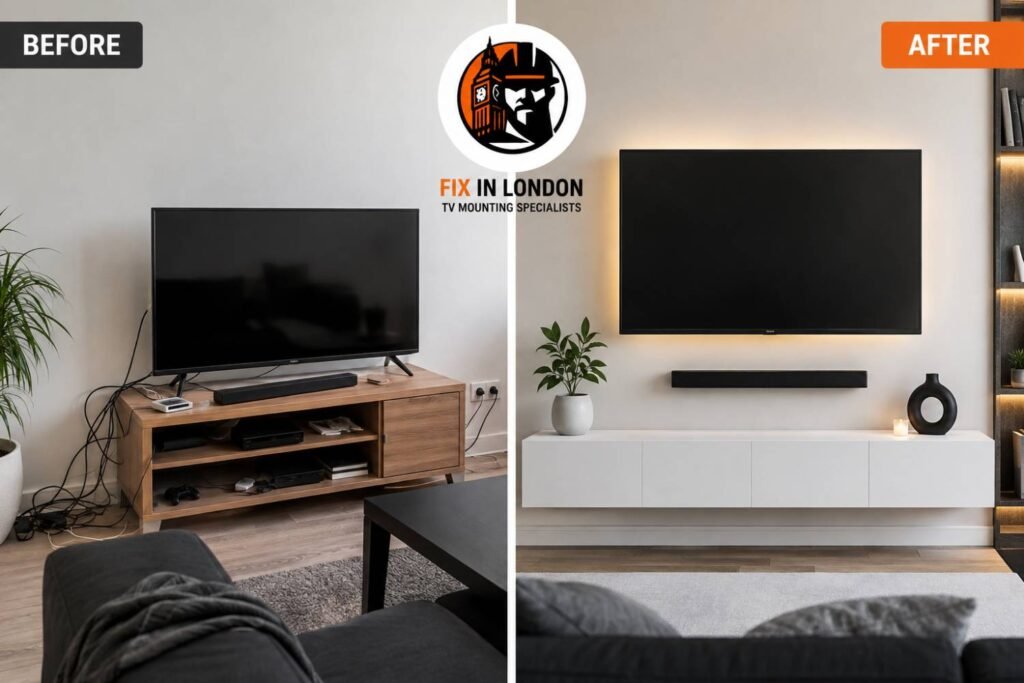
Buying a new television is exciting, but one question quickly follows: Can You Mount a TV Yourself?
The short answer is yes, but whether you should depends on your DIY skills, the type of wall in your home, the size of the television, and the tools available. Many homeowners in London attempt to mount a TV themselves to save money, only to discover hidden challenges such as drilling into brick walls, finding timber studs, concealing cables, or safely lifting a large screen.
A poorly installed television isn’t just unattractive—it can become a serious safety hazard. An incorrectly secured bracket may damage your wall, pull away over time, or even cause your TV to fall, resulting in costly repairs or injuries.
This guide explains everything you need to know before deciding whether to mount your TV yourself. You’ll learn the advantages and disadvantages of DIY installation, the tools you’ll need, common mistakes to avoid, and when it’s worth calling a professional TV mounting service such as Fix in London.
Quick Answer
If you’re asking “Can You Mount a TV Yourself?”, here’s a simple answer:
Situation | DIY Suitable? |
Small TV (32–43″) on a solid brick wall | ✅ Usually yes |
Medium TV (43–55″) with proper tools | ✅ Possible |
Large TV (65″+) | ⚠️ Better with two people |
Plasterboard wall without locating studs | ❌ Not recommended |
Hidden electrical wiring or pipework | ❌ Professional installation advised |
Need concealed cables and perfect alignment | ✅ Professional service preferred |
For many homeowners, DIY installation is perfectly achievable. However, if you’re unsure about the wall construction or don’t have the right equipment, hiring an experienced installer can save time, prevent damage, and provide peace of mind.
Why More Homeowners Are Mounting Their TVs
Wall-mounted televisions have become increasingly popular across London homes, flats, and apartments. Modern TVs are larger than ever while becoming thinner and lighter, making wall installation an attractive alternative to traditional TV stands.
Some of the biggest benefits include:
- Saving valuable floor space
- Creating a modern, minimalist appearance
- Improving viewing angles
- Reducing cable clutter
- Keeping televisions away from children and pets
- Enhancing overall room design
Whether you’re installing a TV in a living room, bedroom, home office or media room, proper mounting can completely transform the space.
Is DIY TV Mounting Right for You?
Not every homeowner has the same experience with DIY projects. Before getting started, ask yourself a few important questions.
You may be able to mount a TV yourself if:
- You’ve used power drills before.
- You know how to use a spirit level.
- You understand different wall types.
- You have someone available to help lift the television.
- You own the correct drill bits and fixings.
DIY may not be suitable if:
- You’ve never drilled into walls.
- Your property has plasterboard walls with unknown stud locations.
- Your television weighs more than 30kg.
- You want hidden cable management.
- You’re unsure where electrical cables or plumbing pipes are located.
Being honest about your abilities is essential. Mounting a TV is more technical than simply hanging a picture frame.
What You’ll Need Before Starting
Having the right tools makes the installation significantly easier.
Essential tools
- TV wall bracket
- Cordless drill
- Masonry or wood drill bits
- Spirit level
- Tape measure
- Pencil
- Stud finder (for plasterboard walls)
- Socket wrench
- Screwdrivers
- Safety goggles
- Vacuum cleaner for dust
Optional but useful:
- Cable trunking
- Cable management kit
- Wall scanner
- Step ladder
Using poor-quality fixings or the wrong wall anchors is one of the biggest reasons TV brackets fail over time.
Step-by-Step Guide to Mounting a TV Yourself
Step 1: Choose the Correct Wall
The first decision isn’t choosing the bracket—it’s choosing the wall.
Ideal walls include:
- Brick
- Concrete
- Solid masonry
- Timber stud walls (when fixed correctly)
Walls that require extra care include:
- Plasterboard
- Drywall
- Dot-and-dab walls
Avoid mounting large televisions directly onto plasterboard without securing the bracket into structural supports.
Step 2: Select the Right TV Bracket
Not every bracket suits every television.
The three most common bracket styles are:
Fixed Brackets
Ideal if you simply want the TV flush against the wall.
Advantages:
- Slim profile
- Lower cost
- Simple installation
Tilting Brackets
Suitable when mounting higher on the wall.
Advantages:
- Reduces glare
- Better viewing angles
- Easy adjustment
Full Motion Brackets
Perfect for open-plan rooms.
Benefits include:
- Swivels left and right
- Tilts up and down
- Extends from the wall
- Flexible viewing positions
Remember to check:
- Maximum TV size
- Weight capacity
- VESA compatibility
Step 3: Find the Perfect Height
One of the biggest DIY mistakes is mounting the television too high.
A good rule is to position the centre of the screen approximately at seated eye level.
Typical viewing heights:
Room | Recommended Centre Height |
Living room | Around seated eye level |
Bedroom | Slightly higher |
Home office | Eye level when seated |
Media room | Based on seating layout |
Take time measuring before drilling.
Small mistakes become very noticeable once the television is mounted.
Step 4: Mark the Drill Holes
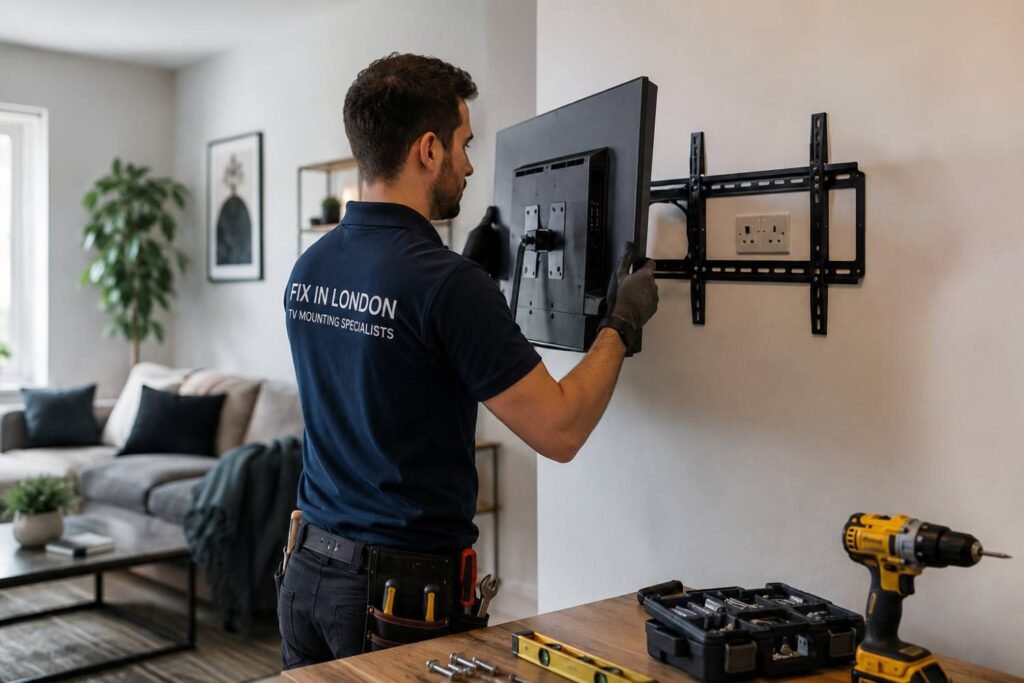
Use the mounting template supplied with your bracket.
Double-check:
- Horizontal alignment
- Vertical spacing
- Distance from furniture
- Cable access
Using a spirit level here prevents the common problem of a crooked television.
Measure twice.
Drill once.
Common Problems People Face During DIY Installation
Even experienced DIY enthusiasts can run into unexpected issues.
Some of the most common include:
Missing Wall Studs
Many homeowners struggle to locate timber studs accurately.
Fixing only into plasterboard dramatically weakens the installation.
Drilling Into Hidden Pipes
Older London properties may have unexpected plumbing routes hidden behind walls.
Accidentally drilling into water pipes can create expensive repairs.
Electrical Wiring
Electrical cables often run vertically or horizontally from sockets.
Without a wall scanner, drilling becomes far riskier.
Crooked TV
Even being a few millimetres out can leave the television visibly tilted.
Using a quality spirit level throughout installation is essential.
Read more: TV Aerial Installation London
DIY TV Mounting Checklist
Before you begin, make sure you can answer yes to these questions:
- Do you know your wall type?
- Do you have the correct fixings?
- Is your bracket rated for your TV’s weight?
- Can someone help lift the television?
- Have you checked for hidden pipes and wiring?
- Do you own the necessary tools?
- Have you planned cable routing?
- Are you confident using a power drill?
If several answers are “no”, professional installation may be the safer option.
Why Wall Type Matters More Than Most People Think
Many people assume all walls are the same, but London homes feature a wide variety of construction methods depending on the property’s age.
For example:
- Victorian homes often have solid brick walls.
- Modern apartments frequently use plasterboard partitions.
- Extensions may combine timber framing with drywall.
- Loft conversions often include stud walls.
Each wall requires different fixings and installation techniques.
Using masonry anchors in plasterboard—or drywall plugs in brick—can seriously compromise the strength of the installation.
That’s why identifying the wall before purchasing your bracket is an important first step.
Can You Mount a TV Alone?
Technically yes—but it’s rarely recommended.
Even lightweight televisions can be awkward to lift while simultaneously aligning mounting hooks.
Large televisions are particularly difficult because:
- They flex during lifting.
- Modern screens have thin bezels that are easy to damage.
- Visibility behind the TV is limited.
- Precise alignment requires two people.
Having another person assist significantly reduces the risk of accidental damage to both the television and your wall.
Common DIY TV Mounting Mistakes to Avoid
Even if you have the right tools, small mistakes can lead to poor results or even serious safety risks. Understanding these common errors can save you time, money, and frustration.
- Choosing the Wrong Wall Fixings
One of the biggest installation mistakes is using the wrong wall plugs or anchors.
For example:
- Standard plastic plugs are unsuitable for heavy TVs on plasterboard.
- Drywall anchors should never be used on solid masonry walls.
- Cheap fixings supplied with low-quality brackets may not support the advertised weight.
Always use fixings appropriate for your wall construction.
Read more: How Much Does a Handyman Cost in London in 2026?
- Ignoring the TV’s Weight
Every wall bracket has a maximum weight limit.
Installing a television that exceeds this limit increases the risk of failure over time.
Before installation, check:
- TV weight
- Bracket weight capacity
- Wall suitability
- Manufacturer recommendations
- Poor Cable Planning
Many homeowners only think about cables after the TV is already mounted.
This often results in:
- Visible hanging wires
- Extension leads across the floor
- Limited access to HDMI ports
- Difficult future upgrades
Planning cable management before drilling makes the finished installation look much cleaner.
- Incorrect Viewing Position
Mounting the TV too high is extremely common.
While it may look impressive initially, prolonged viewing can cause:
- Neck strain
- Shoulder discomfort
- Poor viewing angles
- Eye fatigue
Comfort should always take priority over appearance.
- Rushing the Installation
Trying to complete the job too quickly often leads to:
- Uneven brackets
- Incorrect measurements
- Damaged walls
- Multiple unnecessary drill holes
Taking your time usually produces a far better result.
DIY Troubleshooting Tips
If you encounter problems during installation, don’t panic. Many common issues have straightforward solutions.
Problem | Possible Cause | DIY Solution |
TV isn’t level | Bracket installed unevenly | Loosen bolts slightly and re-level |
Bracket feels loose | Incorrect fixings | Replace with suitable anchors |
TV won’t hook onto bracket | Incorrect VESA arms | Recheck assembly instructions |
Wall crumbles while drilling | Weak plaster | Use appropriate fixings or seek advice |
Cables won’t fit | Poor planning | Consider cable trunking or spacers |
Never ignore a loose bracket or unstable installation. If something doesn’t feel secure, stop using the TV until the issue is resolved.
Safety Should Always Come First
A wall-mounted television may weigh anywhere between 10kg and over 40kg.
If the installation fails, the consequences can include:
- Serious injury
- Damage to expensive electronics
- Broken furniture
- Structural wall damage
- Risk to children and pets
Before hanging your television, always double-check:
- Every fixing is tight.
- The bracket is securely attached.
- The wall is suitable.
- The television locks correctly onto the bracket.
- No movement is present after installation.
Never compromise on safety simply to save a little time.
When Should You Hire a Professional?
Although many smaller TVs can be mounted successfully as a DIY project, there are situations where professional installation is the smarter choice.
You should consider hiring an expert if:
- Your TV is larger than 65 inches.
- You have a plasterboard wall with uncertain stud locations.
- You want cables hidden inside the wall.
- Your property has older brickwork.
- You’re mounting above a fireplace.
- You’re installing multiple televisions.
- You don’t own the required tools.
- You simply want complete peace of mind.
Professional installers have the equipment, experience, and knowledge to complete the job safely and efficiently.
Why Choose Fix in London?
If you’ve decided that DIY isn’t the right option, Fix in London provides professional TV wall mounting services across London for homeowners, landlords, tenants, and businesses.
Choosing an experienced installer offers several advantages:
- Accurate positioning for the best viewing experience
- Secure installation using suitable fixings
- Safe mounting on brick, concrete, or plasterboard walls
- Neat cable management options
- Reduced risk of wall damage
- Faster installation
- Professional finish
Rather than spending an entire weekend measuring, drilling, and troubleshooting, many homeowners prefer having the work completed professionally in a single visit.
Whether you’re installing a television in your living room, bedroom, office, or commercial premises, Fix in London can ensure the installation is completed safely and to a high standard.
DIY vs Professional TV Mounting
Feature | DIY Installation | Professional Installation |
Initial cost | Lower | Higher upfront |
Installation time | Several hours | Usually much quicker |
Risk of mistakes | Higher | Very low |
Wall damage risk | Moderate | Minimal |
Hidden cable options | Limited | Excellent |
Tools required | Yes | No |
Safety | Depends on experience | Professional standard |
Finish quality | Variable | Clean and precise |
For confident DIY enthusiasts, installing a smaller television can be a satisfying project.
However, for larger TVs or more complex installations, professional fitting often provides better long-term value.
Frequently Asked Question: Can You Mount a TV Yourself?
Yes, you can mount a TV yourself if you have the correct tools, understand your wall type, and follow the manufacturer’s instructions carefully.
However, larger televisions, plasterboard walls, concealed cable installations, and uncertain wall structures are situations where professional installation is strongly recommended for safety and reliability.
Final Thoughts
So, Can You Mount a TV Yourself?
The answer is yes—but only if you’re confident in your DIY abilities, have the right equipment, and understand how to mount the bracket securely.
A successful TV installation isn’t just about drilling a few holes. It requires careful planning, accurate measurements, suitable wall fixings, and a strong understanding of the wall you’re working with.
If you’re ever unsure, it’s always better to seek professional assistance than risk damaging an expensive television or compromising your home’s safety.
For homeowners across London looking for a safe, neat, and reliable installation, Fix in London offers professional TV wall mounting services tailored to your property and your needs.
Ready to Mount Your TV?
Whether you’ve purchased a brand-new television or you’re upgrading your living space, don’t leave the installation to chance.
Contact Fix in London today for expert TV wall mounting services and enjoy a secure installation, a professional finish, and complete peace of mind.
Frequently Asked Questions
- Can you mount a TV yourself without professional help?
Yes. If you have the correct tools, suitable wall fixings, and basic DIY experience, many TVs can be safely mounted by homeowners. Larger screens or difficult wall types may require professional assistance.
- Is it safe to mount a TV on a plasterboard wall?
Yes, but only when the bracket is securely fixed into timber studs or installed using appropriate heavy-duty fixings designed for plasterboard walls. Simply fixing into plasterboard alone is not recommended for heavier televisions.
- What tools do I need to mount a TV?
Most installations require a drill, suitable drill bits, a spirit level, tape measure, screwdriver, socket wrench, pencil, and the correct wall anchors. A stud finder and wall scanner are also highly recommended.
- How much does professional TV wall mounting cost in London?
The cost depends on factors such as TV size, wall type, bracket style, and whether cable management is required. While DIY can save money initially, professional installation often reduces the risk of costly mistakes and ensures a secure, high-quality finish.